Smart Thermostats in Italy: What Works with Local Heating Systems

Italy's residential heating stock is diverse in ways that affect smart thermostat compatibility more than buyers usually anticipate. A device marketed as "universal" often assumes the wiring conventions of Northern European or North American systems — neither of which maps cleanly onto the 230V zone valves, older Italian boiler controllers, or radiant floor installations common here.
This article covers the main heating configurations found in Italian homes, the thermostat wiring and voltage requirements they create, and which smart thermostats handle each case reliably.
The Most Common Heating Configurations in Italy
Centralised Building Heating (Riscaldamento Centralizzato)
Many apartment buildings built before 1990 use a shared boiler that circulates hot water through the entire building on a schedule set by the building administrator. Individual apartments have radiators but no independent boiler. In this configuration, a smart thermostat can only control zone valves on individual radiators — it cannot control the boiler's on/off state. The Danfoss Eco and the AVM FRITZ!DECT 301 are radiator valve heads that attach directly to TRV-compatible (thermostatic radiator valve) stems and control flow through the valve electronically.
Individual Apartment Boilers (Caldaia Autonoma)
Since the 1990s, most new Italian apartments and many renovated ones have individual gas condensing boilers. These connect to a wall thermostat through a two-wire "dry contact" circuit: the thermostat closes the circuit to call for heat, opens it when satisfied. This is the configuration that almost every smart thermostat is designed for.
Devices like the Netatmo Smart Thermostat, Tado° Smart Thermostat V3+, and Bosch CT200 connect via two wires to the boiler's TA terminals. Most Italian boilers from Vaillant, Baxi, Ariston, and Beretta expose these terminals in the same position on their wiring diagrams.
Radiant Floor Heating (Riscaldamento a Pavimento)
Radiant floor systems circulate warm water through pipes embedded in the floor slab. They're common in newer buildings and renovations completed after 2000. Floor heating responds slowly — it takes an hour or more for the floor temperature to change significantly — which means the thermostat's scheduling algorithm matters more than with radiators.
Floor heating systems in Italy typically use a manifold with zone valves that receive 230V signals, or 24V signals depending on the manufacturer. This is where compatibility issues most commonly arise: a thermostat rated for 24V systems (common in the US) will not drive 230V Italian zone valves without a relay.

Voltage: The Critical Compatibility Factor
Italian zone valves on radiant floor systems typically operate at 230V. Many thermostats sold in European retail — including some Netatmo and Tado° models — have a maximum switching voltage of 24V or use proprietary extensions for higher voltages. Connecting a 24V-rated thermostat to a 230V zone valve will damage the thermostat's relay and may create a safety hazard.
The correct approach for 230V systems is to use a thermostat with a relay rated for 230V, or to install an intermediate relay/actuator that accepts a 24V or dry-contact signal from the thermostat and switches 230V to the valve. The Tado° Wiring Adapter is designed for exactly this scenario. Salus Controls, a brand well-distributed in Italy through HVAC suppliers, makes thermostats and actuators designed specifically for European floor heating voltages.
Device Overview
AVM FRITZ!DECT 301
A radiator valve head that attaches to standard M30 TRV adapters. Uses DECT ULE radio (not Zigbee or Z-Wave) and requires an AVM FRITZ!Box router to operate. It reports actual room temperature, supports weekly schedules, and integrates with the FRITZ!Box's home automation interface. Widely available in German electronics retail; available in Italy through online importers. Best suited for apartments with centralised building heat and individual TRV radiators.
Netatmo Smart Thermostat
Controls an individual boiler through a two-wire connection. Works with OpenTherm where supported (allowing modulation rather than simple on/off), though Italian boilers with OpenTherm support are more common in higher-end models. Controlled through the Netatmo app; integrates with Apple HomeKit natively and with Google Home / Amazon Alexa through the app. Compatible with most Italian autonomous boilers (caldaia autonoma) without additional hardware.
Tado° Smart Thermostat V3+
Similar two-wire connection for boiler control. Tado°'s Auto-Assist subscription improves geofencing accuracy (optional). The wiring adapter extension handles floor heating zone valves at 230V. Available at Unieuro, MediaWorld, and Amazon Italy. Integrates with Apple HomeKit, Google Home, and Amazon Alexa.
Salus Controls (iT500)
Designed explicitly for European heating systems including 230V floor heating. No cloud subscription required for basic function — scheduling runs locally. Wi-Fi connected, controlled through the Salus App or via third-party integration with Home Assistant. Widely used by Italian HVAC installers. Less known to consumers but more appropriate for floor heating than consumer-market devices.
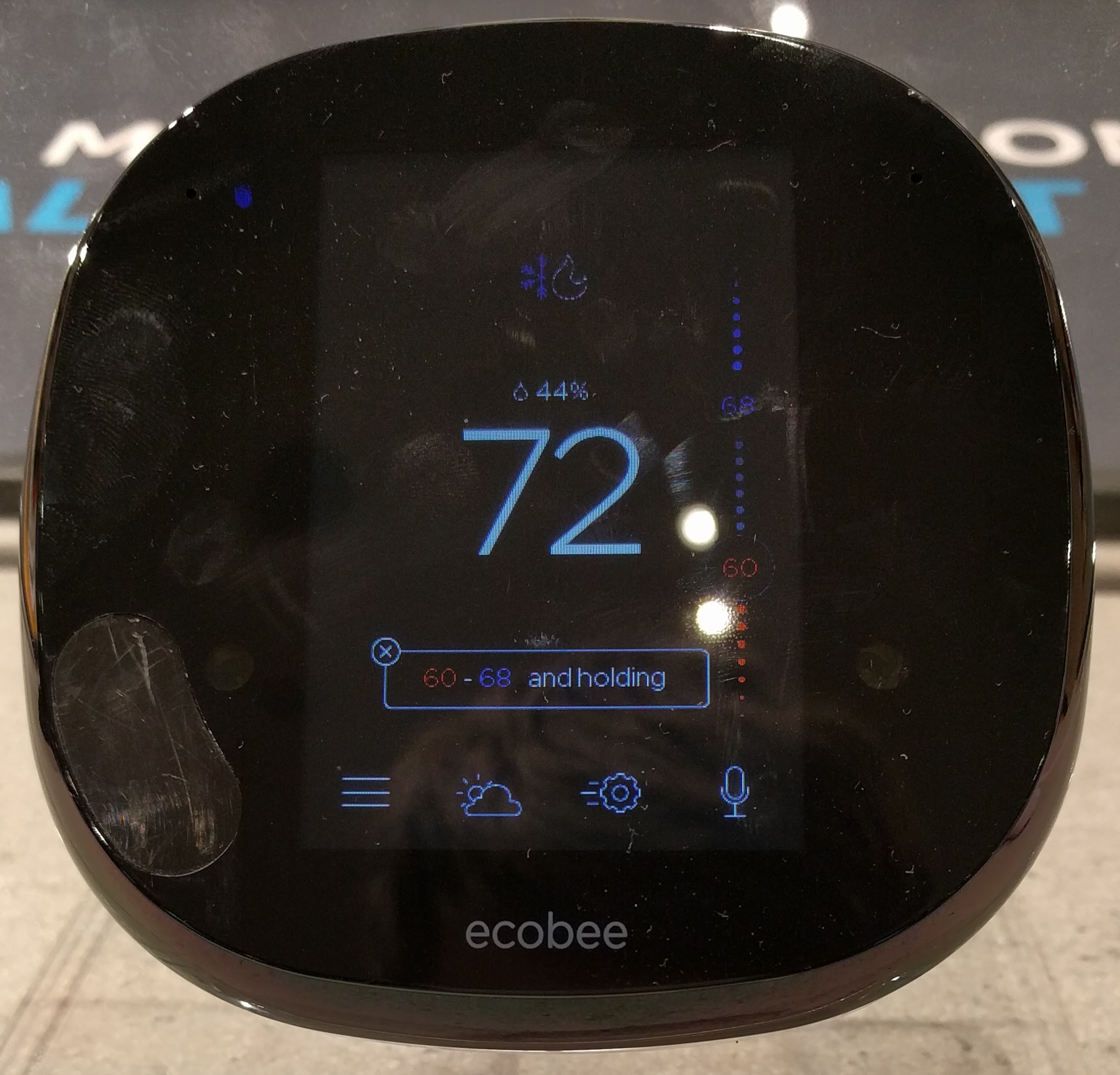
Ecobee SmartThermostat Premium
Designed for North American HVAC systems and requires 24V C-wire. Not compatible with Italian systems without significant relay additions. Mentioned here specifically because it appears in Italian online marketplaces imported from the US — it does not work with standard Italian boilers or zone valves without significant additional wiring work.
Wiring Considerations for Italian Installers
Italian residential electrical installations use 230V single-phase mains. Heating circuits in older buildings often have no neutral wire run to the thermostat location — only the two switched wires. This matters because some smart thermostats require a neutral wire to power their electronics. Models that don't require a neutral (like Tado° V3+ and Netatmo) steal a small amount of current through the boiler's valve coil, which works in most cases but occasionally causes issues with sensitive boilers.
The safe approach when running new wire during renovation is to pull a three-wire cable to the thermostat position, providing live, neutral, and switched. This future-proofs the installation for any thermostat choice.
Integration with Home Automation Systems
For households already running a Zigbee or Z-Wave network, Zigbee-compatible thermostats avoid adding another protocol to the mix. The Eurotronic Spirit Zigbee is a radiator valve head compatible with Zigbee 3.0 hubs. The Danfoss Ally uses Zigbee and is available from Italian plumbing suppliers through the Danfoss distributor network.
Home Assistant integrates with most of the above through native or community-maintained integrations. The Salus iT500, Tado°, and Netatmo all have established Home Assistant components. Radiator TRV devices using Zigbee integrate through the standard Zigbee integration (ZHA or Zigbee2MQTT).